
Undercurrents
I hope you are enjoying the cooler months and the changing of the seasons.
During the third quarter of 2026, the major index returns were mixed with indexes containing Mega-Tech producing small gains and smaller company and bond indexes falling. The S&P 500 Index gained 2.0%, the NASDAQ Index gained 2.5%, the Russell 2000 Growth Index lost 9.5%, and the iShares Barclays 7-10 yr. Treasury Bond ETF (IEF) was down 5.6%.[1]
Bonds were down again due to a surge in inflation, persistent U.S. deficit borrowing, and expectations of further interest rate hikes. The mixed stock market results revolved around the price of oil, high prices of AI stocks, and expectations about future interest rate moves.
Areas of strength included energy related and oil stocks and only a select group of AI related names. Higher oil prices and rising interest rates put pressure on cyclical and consumer-oriented stocks. Small business (small-cap) returns, as measured by the Russell 2000 Indexes, were down since traditionally higher borrowing costs and elevated energy expenses disproportionately hit small-caps with weaker balance sheets and debt structure.
Small-cap health appears to be stable despite the elevated price of oil, current inflation, higher interest rates, and geopolitical conflicts. Small-caps also appear to be inexpensive and can create opportunity once the situation in Iran calms down and we get through the mid-term elections.
Today, the S&P 500 Index is priced at its 10-year average forward P/E. In other words, the S&P index price reflects a price derived from current and future thoughts of investors, expressed by the buying pressure of all the “Bull” investors and selling pressure of all the “Bear” investors. Since the price is on its 10-year forward average, it reveals that there is no certainty that today’s macro conditions are better or worse than the past decade.
On the other hand, the Shiller P/E ratio currently hovers between 40.7x and 41.9x, holding firmly as the second-highest valuation peak in 150 years of market history. This puts today’s stock market in a rare territory only surpassed by the all-time high of 44.19x recorded in December 1999 at the absolute peak of the Dot-Com bubble.
[1] These returns are price based and exclusive of dividend reinvestment. Return data provided by QUODD Financial, ETFreplay.com, and Yahoo Finance.
This is a danger sign.
The Shiller P/E Ratio, aka Cyclically Adjusted Price-to-Earnings (CAPE) ratio is named after Robert Shiller, who is a Nobel Prize winner, best known as a pioneer of behavioral finance. His recent popularity is likely to revolve around his accurate warning about the early-2000s dot-com bubble and the 2008 housing crash in his best-selling book Irrational Exuberance.
His two warnings are data points and not certainty.
The Shiller P/E ratio divides a stock or market index’s price by the average of 10 years of past earnings, adjusted for inflation, to smooth out business cycle fluctuations. It exists for many as a predictive tool to “even out” the view of earnings and eliminate noise presented by business cycle fluctuations.
Most successful investors go well beyond considering only valuations in making long-term winning results. Today’s current technology far surpasses what we thought could be possible in taking data points, ratios, equations, and accepted theories in an attempt to construct winning portfolios. The difficulty of using these market attributes is that they are derived from past results while we invest for the future.
To be successful, one must use the past as a general framework, but then look forward to calculate future prices with realistic assumptions. This is where it becomes difficult since human emotion comes into play. We all interpret the world differently, to differing degrees, and are swayed differently by inputs such as data, the internet, blogs, personalities…
I have been fortunate in my 40 plus career of portfolio management to have an upbringing which fostered such forward looking traits and it has benefitted the portfolios I manage.
Not to get too far off track, but I have a quick insight into my past. My father, Dr. Akihiko Yokosawa, a high-energy nuclear physicist looked ahead using his deep knowledge of physics, mathematics, and engineering to dispel a well-known understanding that protons and electrons could not be combined since the closer they become, the more they repel. After years of work, he did combine protons into what is now termed as the Yokosawa di-proton.
His tenacity, discipline, and recognition of not relying only on past statistics and theory has profoundly formulated on how I should conduct myself in life and my work.
Are higher interest rates a sign of inflation, or a transitory increase in oil prices due to the Iranian conflict, Ukraine’s bombing of Russian refineries, institutions selling bonds to raise capital for AI IPO’s (initial public offering of stock), or the massive government debt the US has created?
What is the outcome of the mid-term elections and how will it affect the government investment into AI?
How long will the Iran conflict impact oil prices?
How will this impact my focus on finding companies which have:
- Sales that are growing and have a runway to continue?
- Positive earnings which are growing?
- A price which is reasonable for future earnings growth?
Beyond these three attributes, there are numerous aspects of a company, the stock market, and economy to evaluate. Another subjective but important aspect is how all the other market participants will evaluate the long-term prospects of the investment. This is where experience makes the difference from investing only by the numbers and market pundits.
So far this quarter, the focus of investors continues to be on interest rates, oil prices, and the economy.
What I see today:
- Interest rates may continue to increase, but not at a significant speed or magnitude. Watching interest rates is important since it affects the level of purchasing power of future earnings. As interest rates rise, future earnings will likely be able to buy less of a product or service. Due to the current level of the markets, my feeling is that market prices have not adequately priced in the current adverse interest rate environment. This is a risk to current prices.
- Oil prices are a major macroeconomic force that significantly influences inflation, transportation costs, consumer spending, and corporate profits. My thinking here is that after the election, the administration will move more forcefully in settling the Iran and Russia/Ukraine conflicts which should result in lower oil prices.
- The U.S. economy has been resilient and continues to expand despite the current headwinds of inflation, higher interest rates, and oil prices. Also, the labor market is stable; U.S. initial unemployment claims fell slightly to 197,000 for the week ending October 3, 2026. Labor is important in the making of Federal Reserve policy. It is foundational to the Federal Reserve because Congress legally requires the central bank to pursue a dual mandate of maximum sustainable employment alongside price stability. If interest rates stabilize, or come down, along with oil prices, the economy would be in a position to do very well. I believe AI spending will continue, but due to the high prices and expectations of many well-known names, there will likely be a change in the names of the companies that do well in the stock market.
Due to the inflated prices and expectations of many Mega-Tech companies which comprise a significant weighting of the broad stock market indexes, there continues to be price risk in those indexes, and a stock market correction is still a concern. A significant amount of money has been thrown at the Mega-Tech stocks to the detriment of other well run and growing companies.
As in the past, we may experience an underlying rotation/profit taking from the largest well-known names to new undiscovered names.
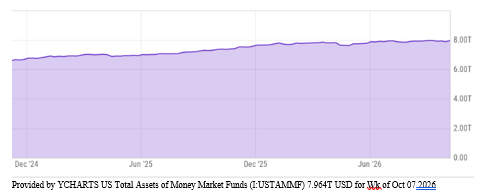
In the event of a stock market correction, the current money market fund level remains near all-time highs of around $8,000,000,000,000.00, yes $8 trillion. This should mitigate a steep prolonged correction since many investors will have the cash to enter the market and buoy it up.
U.S. Total Assets of Money Market Funds
Going forward into the quarter it appears the profitable and value small-cap stocks seem to be undervalued, and that consensus estimates are pointing to faster earnings growth ahead. Many are anxious for the slated IPOs for Anthropic (ANTP) and OpenAI (OAI) in the coming months, but I’m skeptical of them due to the high level of hype.
Again, I believe today that the market will be higher for the year, but there may be near-term weakness. The investing landscape is changing, and I am excited about the upcoming earnings season for confirmation of revenue and earnings growth by owned companies and for new opportunities.
Very truly yours,
Martin L. Yokosawa
Torii® Asset Management, Inc. Landolt Securities, Inc.
9S040 Stearman Drive, Naperville, IL. 60564
Copyright Martin L. Yokosawa. All Rights Reserved
Securities processed by and investment advice provided through Landolt Securities, Inc. Member: FINRA/SIPC
Torii Asset Management, Inc. and Landolt Securities, Inc. are not affiliated companies.